4-Week At-Home Workout Plan (Minimal Equipment)
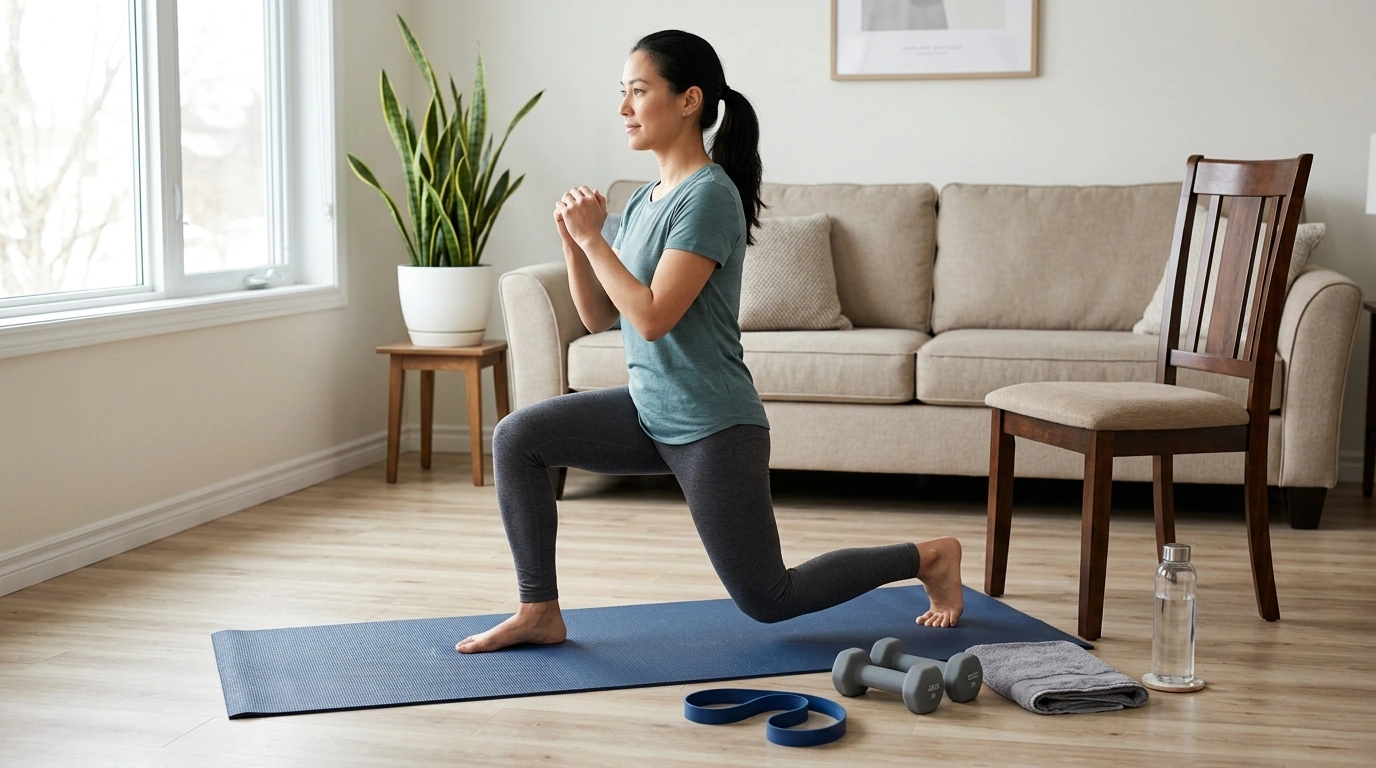
Fit at Home: A 4-Week Minimal-Equipment Routine You Can Repeat
A consistent four-week plan can help build strength, improve mobility, and make workouts feel automatic—without needing a full gym. With a small space and a few optional tools (or smart substitutions), it’s possible to train your legs, upper body, core, and conditioning while still protecting recovery. This approach focuses on simple daily structure: warm-up, main work, optional finisher, then a short stretch sequence to keep you moving well.
For general health, many guidelines recommend combining regular strength work with weekly moderate activity; you can compare targets via the CDC’s adult physical activity guidance and the World Health Organization (WHO) recommendations.
What This 4-Week Plan Helps With
- Full-body strength using bodyweight plus optional tools like bands, light dumbbells, and a stable chair/bench.
- Better mobility through short, repeatable stretch sequences after each workout day.
- A structured daily checklist to reduce decision fatigue and improve consistency.
- Progression across four weeks by adjusting reps, tempo, rest time, and difficulty—not just adding equipment.
- A balanced weekly split: lower body, upper body, core/stability, and recovery-focused days.
Minimal Equipment Setup (And No-Equipment Substitutions)
- Space: clear an area about the size of a yoga mat; a wall is helpful for balance and support.
- Optional tools: resistance band/loop, light-to-moderate dumbbells, jump rope, and a mat for comfort.
- Simple substitutions: a backpack with books for load, a towel for isometrics, stairs for step-ups, and a countertop for incline push-ups.
- Safety basics: avoid wobbly chairs, use non-slip flooring (barefoot can be fine), keep water nearby, and stop if pain feels sharp or radiating.
- Time range: most sessions fit into 20–40 minutes including warm-up and cooldown.
How the Daily Workouts Are Structured
- Warm-up (5–8 minutes): joint circles, light marching, hip hinges, and shoulder openers to raise body temperature and rehearse patterns.
- Main circuit (12–25 minutes): 4–8 movements grouped by pattern (squat/hinge/push/pull/core) with planned rest.
- Finisher (optional, 3–6 minutes): short conditioning or an extra core block when energy is high.
- Cooldown + stretches (5–10 minutes): breathing plus gentle holds for hips, hamstrings, chest, and upper back.
- Tracking: note reps, perceived effort (easy/moderate/hard), and any joint discomfort so you can progress with control.
Sample Week Schedule (Repeat With Progression Over 4 Weeks)
Use this template as your weekly “default.” Repeat it for four weeks while slightly increasing challenge each week (more reps, slower tempo, less rest, or tougher variations). If five training days feels like too much, drop one strength day but keep the mobility/recovery day. If training six to seven days, keep at least one lower-intensity recovery day and prioritize sleep.
| Day | Focus | Main Moves (examples) | Stretch Focus |
|---|---|---|---|
| Day 1 | Lower Body Strength | Squat or sit-to-stand, reverse lunge, glute bridge/hip thrust, calf raises | Hip flexors, quads, glutes |
| Day 2 | Upper Body Strength | Incline/regular push-ups, band/dumbbell rows, overhead press variation, biceps/triceps accessory | Chest, lats, shoulders |
| Day 3 | Core + Conditioning | Dead bug, plank variation, mountain climbers or low-impact cardio intervals | Spine-friendly rotation, hamstrings |
| Day 4 | Mobility + Recovery | Easy walk or gentle flow, balance work, breathing drills | Full-body mobility (hips/ankles/thoracic) |
| Day 5 | Full-Body Strength | Hinge (RDL/backpack deadlift), squat pattern, push pattern, pull pattern, carries | Posterior chain, upper back |
| Day 6 | Optional Cardio or Light Strength | Bike/walk/rope intervals or light technique circuits | Calves, ankles, light full-body |
| Day 7 | Rest | Rest or gentle walk | Relaxation breathing, light stretching |
Progression Across 4 Weeks (Without Needing More Equipment)
- Week 1: learn form and establish a baseline; stop each set with 2–3 reps “in reserve.”
- Week 2: add volume (one extra set on key moves) or add 2–4 reps per set while keeping technique clean.
- Week 3: increase intensity via tempo (3 seconds down, 1 second pause) or reduce rest between sets.
- Week 4: consolidate with a “quality week” (complete sessions, controlled tempo, consistent effort) instead of max testing.
- When to level up: you can control the movement, feel no pain, balance is stable, and breathing stays steady.
If you want more context on broad exercise programming principles and safety considerations, the American College of Sports Medicine (ACSM) guidance is a helpful reference point.
Daily Stretches That Pair Well With Home Workouts
- Lower body staples: hip flexor stretch, hamstring stretch, calf stretch against a wall, figure-four glute stretch.
- Upper body staples: doorway chest stretch, lat stretch on a chair, thoracic rotation on hands-and-knees.
- Hold times: 20–45 seconds per stretch; prioritize slow breathing over forcing range.
- Best timing: light dynamic mobility before training; longer static holds after training or on recovery days.
- Pain rule: stretching should feel like tension, not sharp or radiating pain.
Common Mistakes That Stall Results at Home
- Skipping warm-ups and jumping straight into hard sets, leading to poor mechanics and avoidable aches.
- Keeping the exact same reps and rest times every week; small planned changes drive progress.
- Turning every workout into a high-intensity session and neglecting recovery, walking, and sleep.
- Ignoring pulling work (rows, band pulls) and overdoing pushing, which can irritate shoulders.
- Chasing soreness instead of repeatable training quality you can sustain week after week.
Recommended Downloads (In Stock)
- Fit at Home: 4-Week Workout Plan (Minimal Equipment PDF eBook)
- Must-Know Pet First-Aid Cheat Sheet (Printable)
- Cat Body Language & Behavior Cheat Sheet (Printable)
Fit at Home: 4-Week Workout Plan PDF eBook (What’s Included)
FAQ
Is there a free PDF download for a full body gym workout book?
There are many free PDFs online, but quality and safety vary. Look for clear progression, form cues, a balanced push/pull/legs approach, and planned rest days; a paid plan often puts a complete four-week schedule with daily workouts and stretches in one organized place.








Leave a comment